Muzeum Szczecin w PRL
About the Museum
Social history and material culture of Szczecin in 1952–1989
01
Museum History
The exhibition's narrative covers the social history and material culture of the Polish People's Republic (1952–1989). The term "PRL" makes many people flinch. You could substitute it with "post-war history", "socialist state" or "Szczecin's turning points" — but it's the same era, with its horrors and its joys.
Post-war Szczecin was the Wild West — a city whose continued place in the "motherland" was uncertain. The inviolability of the borders was declared in Szczecin by Nikita Khrushchev in July 1959. The port city was defiant; its residents raised a clenched fist to communist authority. At the same time there were films at the panoramic Kosmos cinema, big beat on the stage of the Young Talents Festival, anniversary dinners at Kaskada, paprykarz at the campsite, Odra jeans, a Wiskord cassette in the tape recorder.
The Szczecin w PRL Museum is the independent, conceptual work of Justyna Machnik. It began with a self-guided walking tour (04/2018) "Szczecin on the PRL Trail". It was complemented — as a bonus — by a single-room exhibition (05/2019–11/2020), visited free of charge only by participants of the walks. Then came the move to a larger space, the organisational struggles, and over a year of building the exhibition. The museum opened in March 2022.
The museum has been featured many times in the press — local media, TVN, Onet. It has won awards (including the "Made in Szczecin" brand), and was included in the English-language guide "About Polska" by the Polish Ministry of Foreign Affairs (2025 edition). Most importantly, it is appreciated by visitors.
PRL Walking Tour
Museum opening
I believe that a visit to my museum strengthens visitors' cultural literacy. I try to break the stereotype that exhibitions about the PRL are made for undemanding audiences and built on (re)sentiment alone. An exhibition is not meant to be viewed in silence — after all, social memory is itself an artefact.
Thursday to Friday I work at a local IT company; on Fridays I open the museum exclusively for booked groups, and on weekends for individual visitors.
After several years of running the museum, I know this project deserves to grow. The museum should move into a different, larger space — with an improved concept and new exhibition solutions. While preserving reverence for the truth of the original object, I would add interactive, multimedia ideas. That's why I'm ready to collaborate — to talk with public offices, institutions, and the business community. A museum that educates and entertains, that unites generations and the Szczecin community, that is a meeting place popularising history and presenting iconic Szczecin places, products and residents — it is far more than a tourist attraction.
02
About the Author
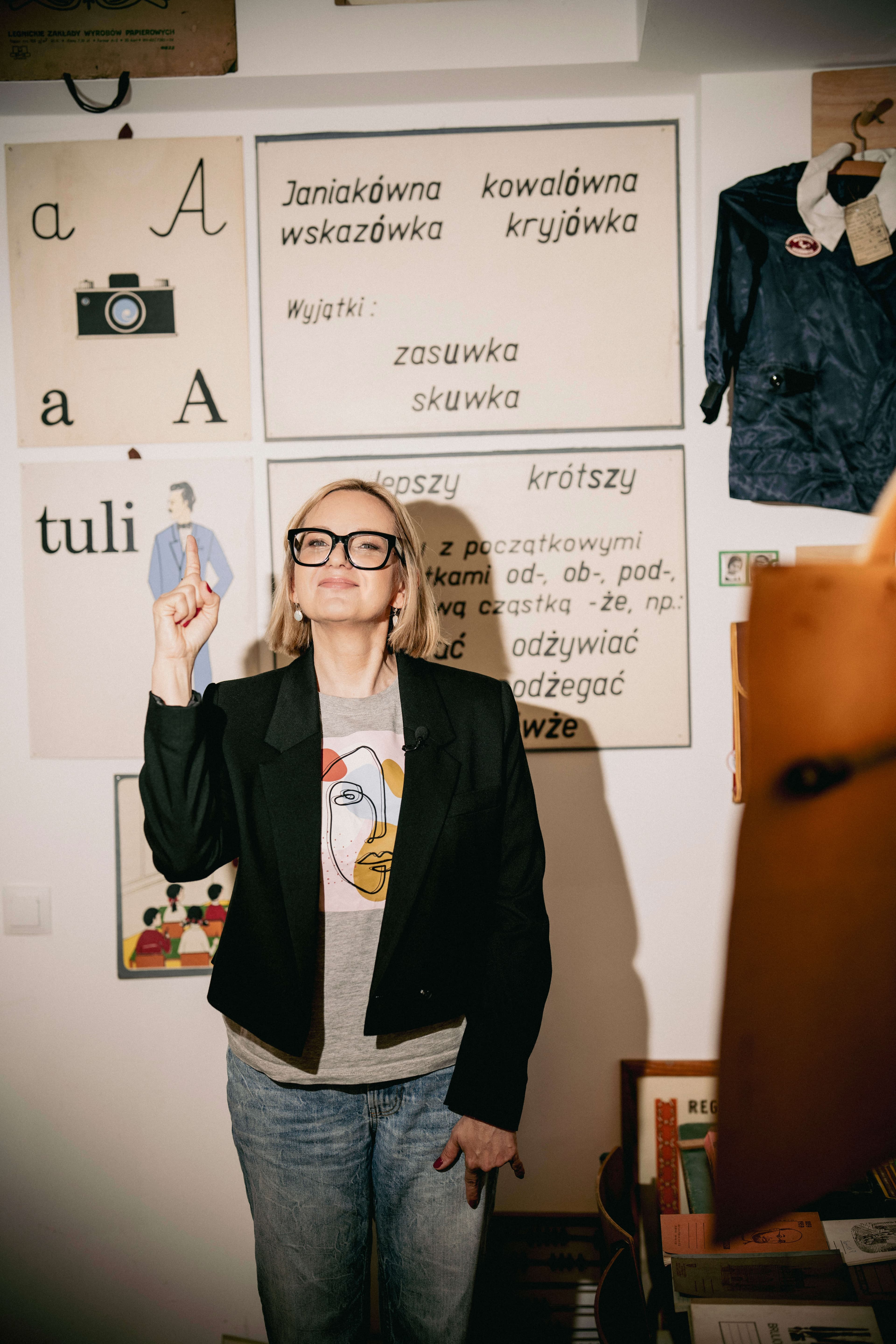
Justyna Machnik
Founder · City Guide
A native of Szczecin, licensed city guide, organiser of urban events, author of independent projects (tenement houses, old crafts, porter cabins / security posts), journalist at Polish Radio Szczecin and Szczecin FM (contributor 2007–2012), author of articles on Szczecin's curiosities. On weekdays she works at a local IT company supporting the sales process for IT systems and, beyond that, runs the Szczecin w PRL Museum. In Szczecin she loves plane trees, granite paving slabs, mosaics, tenement houses and the city's hidden backstages.
She went to school wearing an apron with a school badge on her sleeve, played elastic band in the yard and made "niebka" ("widoczki"), and after the Wieczorynka cartoon she slept on a sofa bed — a child of the PRL.
The Szczecin w PRL Museum is an extension of her story about Szczecin — and every object in the exhibition is a message from those years and a self-evident vessel of memory.
03
Key information
- 1An exhibition about everyday life during the Polish People's Republic.
- 2Themed zones: Szczecin (places, workplaces, culture, music, flavours, trinkets), time travel, the home, the allotment, childhood, a party official's office, trade, crafts, sport and leisure.
- 3A showcase of typography, patterns and design — confronting the phenomenon of cult status and nostalgia.
- 4Descriptions in three languages: Polish, English and German.
- 5Children visiting with their parents receive an activity sheet — a series of puzzles tailored to the tour path and to the thematic and scenographic sequences.
- 6Interactive museum lessons for primary, secondary and university students.
- 7Group visits possible at non-standard times, e.g. evenings on a weekday.
- 8Opening days: irregular schedule — usually Saturdays and Sundays 12:00–15:00 for individual visitors, and Fridays for groups by prior reservation at a set time between 09:00–15:00. Please check Facebook before your visit for current updates.